
Crop Robotics Market Expands in Europe as AI and M&A Accelerate Development
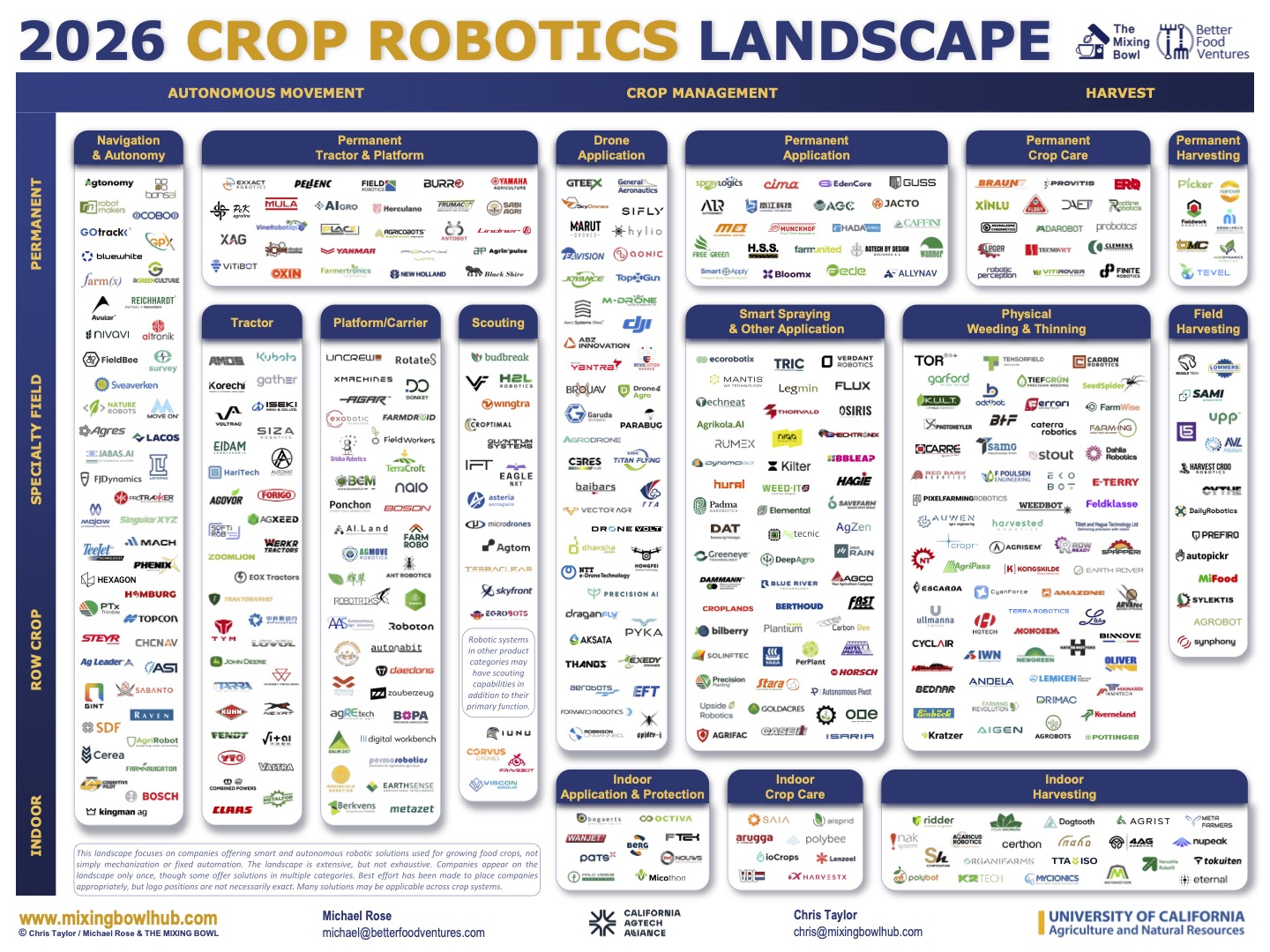
The agricultural robotics sector is experiencing a period of intense evolution, marked by high market dynamism, rapid technological integration, and significant consolidation. According to the latest Crop Robotics landscape report by agrifood innovation hub The Mixing Bowl, the sector now tracks around 400 companies globally across 15 distinct categories, representing a 25% expansion compared to 2024 figures.
Despite this growth, the market remains characterized by high volatility. Industry analysts point out notable structural churn within the sector, with roughly 20% of previously tracked startups exiting the market while over a third of the current landscape consists of new entrants. Interestingly, Europe plays a dominant role in this ecosystem, accounting for fully half of the total companies featured in the global report.
Commercialization has advanced furthest in precision weeding and spraying applications. Farmers across Europe and North America are increasingly adopting these tools as reliable alternatives to traditional chemical applications, driven largely by tightening regulatory constraints on crop protection products and persistent rural labor shortages. This strong commercial traction has altered business models and intensified direct competition among machinery developers.
Meanwhile, major original equipment manufacturers are actively reshaping the competitive landscape through aggressive mergers, acquisitions, and strategic partnerships. Industry giants like John Deere, Kubota, and Yamaha are acquiring specialized robotics firms or investing heavily in early-stage startups to secure advanced artificial intelligence and computer vision portfolios. This consolidation trend allows well-funded startups to absorb smaller peers, concentrating critical talent and capital.
Despite these advancements, harvesting remains the most technically complex and laggard segment in agricultural automation. Developing autonomous machines capable of accurately navigating dense canopies and selectively picking delicate fruits or vegetables without causing damage requires the synchronization of numerous high-level technologies. Nevertheless, ongoing improvements in machine learning and predictive AI models are expected to accelerate overall system deployment on modern farms.