
TerraBlaster Secures $12.5M to Bring Real-Time Soil Mapping to Commercial Farms
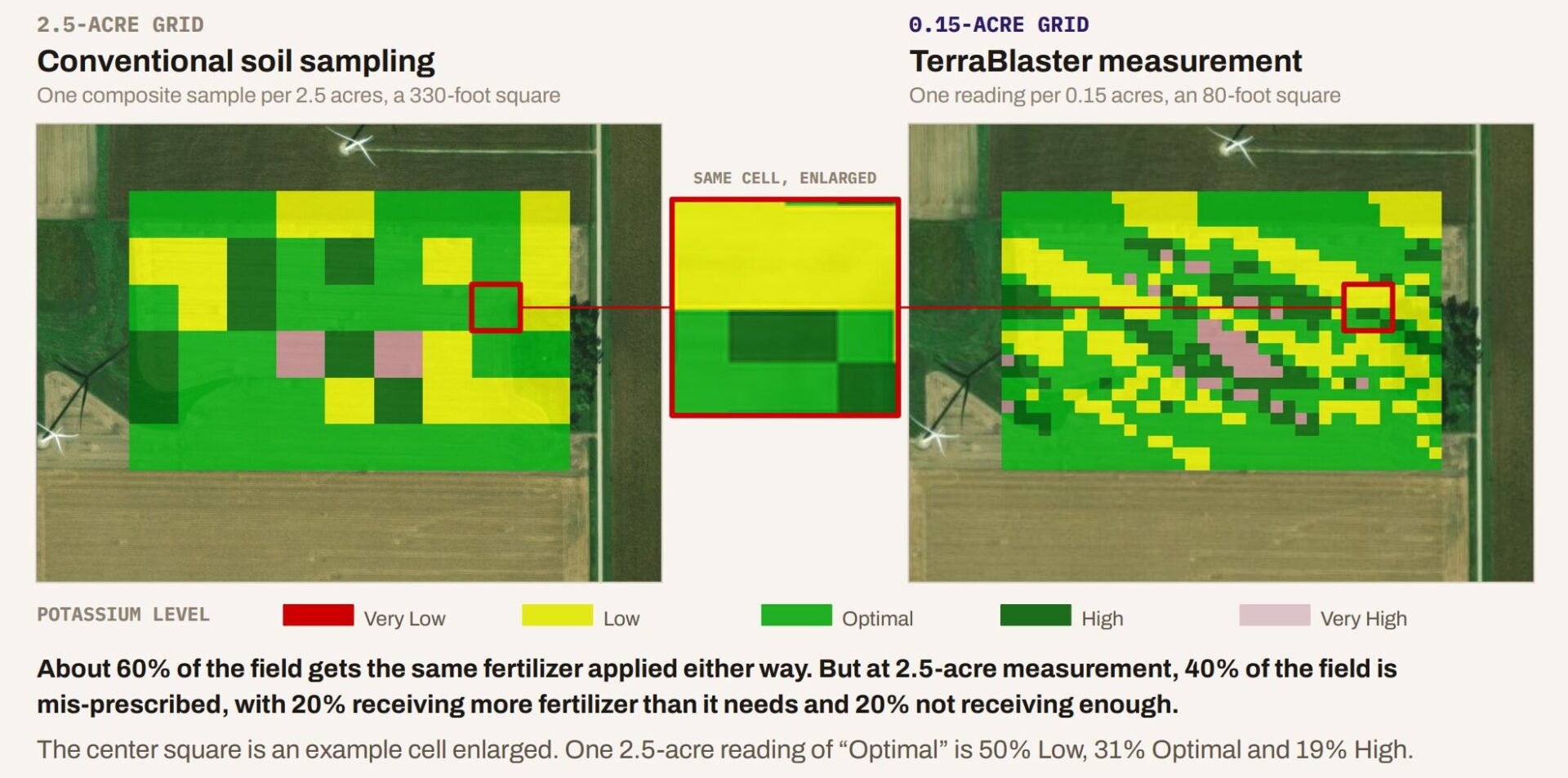
Precision agriculture is set for a significant shake-up as TerraBlaster, a startup utilizing laser-induced breakdown spectroscopy (LIBS)—the same technology used to analyze soil on Mars—has raised $12.5 million in seed funding. The company aims to transition from testing to commercial availability by 2027, offering a faster alternative to traditional lab-based soil sampling.
Currently, farmers typically rely on soil grids of 2.5 acres, a method that often misses localized nutrient deficiencies or excesses. TerraBlaster’s towed hardware seeks to bridge this gap by measuring nitrogen, phosphorus, potassium, and pH levels at a much finer resolution of 0.15 acres. By dragging the sensor through the soil at tractor speeds, operators can generate high-fidelity fertility maps without the wait times associated with laboratory analysis.
The economic argument for such systems is centered on two main pillars: reduced input costs through variable-rate application and potential yield increases. By identifying "hidden" nutrient variability within a single field, farmers can stop over-fertilizing areas that don't need it and target under-performing zones that are currently limiting yields. The company estimates potential gains of $35 per acre in corn and soy operations.
While the hardware is currently being calibrated for speeds of 5mph, the long-term goal is to integrate these sensors directly into planting or tillage equipment. This would allow farmers to monitor soil chemistry while performing other necessary field tasks, effectively removing the need for a separate pass through the field just for mapping.
Practical takeaway: By 2027, farmers should expect more competition in the precision soil mapping market, potentially lowering the barrier to entry for variable-rate fertilization programs. Keep an eye on local technology demonstrations this fall to evaluate if the cost-per-acre savings of on-the-go scanning can replace your current lab-sampling budget.
— agronom.work editorial team